
As autumn arrives, a familiar sense of anticipation fills Indian homes across the world. From the vibrant beats of Garba during Navratri to the radiant glow of diyas on Deepawali night, this season marks a journey — from the victory of good over evil to the triumph of light over darkness.
For the Indian diaspora, scattered across continents yet connected by shared memory, Dussehra to Deepawali is more than a sequence of festivals. It’s a reminder of balance — between emotion and reason, faith and science, tradition and modernity. Let us take a modern, even scientific, look at what these celebrations mean in today’s world.
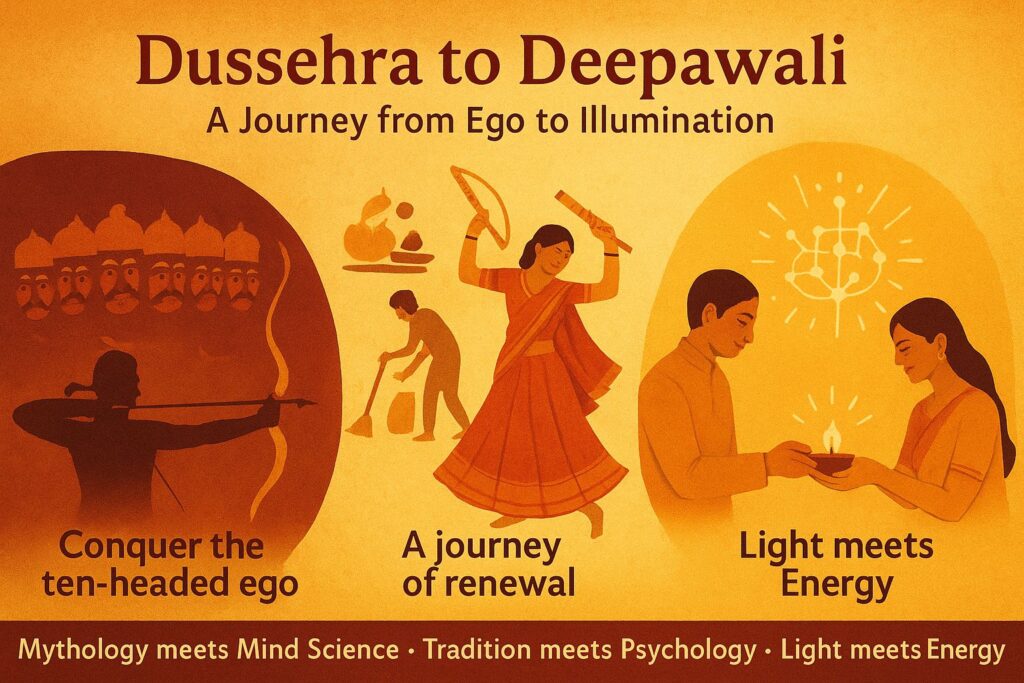
Dussehra: The Victory of Mind Over Ego
Dussehra, or Vijayadashami, marks the end of Navratri — a time when we celebrate the victory of Lord Rama over Ravana, or Goddess Durga’s triumph over Mahishasura. On the surface, it’s a tale of good conquering evil. But if we peel away the mythology, we find a deeply psychological lesson.
Ravana’s ten heads symbolize not ten different persons, but ten facets of human ego — anger, greed, lust, jealousy, pride, attachment, and more. His defeat, then, represents the mastery of one’s lower instincts through discipline and awareness.
Modern neuroscience would agree. The conflict between Rama and Ravana mirrors the struggle between our prefrontal cortex (the seat of reasoning) and our limbic system (the center of emotion and desire). True victory — Vijaya — lies in the balance between the two.
In that sense, Dussehra isn’t merely about burning effigies; it’s about confronting the symbolic “Ravana” within us — the voices of distraction, negativity, and excess that prevent inner growth.
The Interval: Cleansing Mind, Body, and Space
Between Dussehra and Deepawali lies a period that our ancestors dedicated to preparation — both outer and inner. This is when we clean our homes, declutter wardrobes, plan new beginnings, and engage in fasting or simple eating.
Interestingly, these customs align beautifully with modern science:
- Fasting helps regulate metabolism, reduces inflammation, and improves mental clarity.
- Decluttering our physical space reduces cortisol (stress hormone) and increases focus.
- Dance and music during Navratri stimulate endorphin release, enhancing social connection and happiness.
From a sociological view, this period also renews social bonds. As families come together, shared rituals reinforce community identity — something especially precious for the Indian diaspora living far from home.
Deepawali: Light, Energy, and Human Psychology
When Deepawali finally arrives, it feels like the natural culmination of this inner journey — from destruction of negativity (Dussehra) to illumination of wisdom (Deepawali). Traditionally, it marks Lord Rama’s return to Ayodhya after exile, or in other regions, Krishna’s victory over Narakasura, or Goddess Lakshmi’s arrival into the cleansed, prepared home.
But let’s look deeper — scientifically and symbolically.
The Light Within and Around
Lighting diyas isn’t just a ritual. It’s an ancient form of light therapy. Exposure to light, especially during autumn and winter, helps regulate melatonin and serotonin levels, improving mood and sleep cycles. Our ancestors may not have spoken in neurochemical terms, but they intuitively understood the healing power of light.
The act of lighting lamps together — in rows that illuminate streets and homes — also creates a shared visual experience that builds collective optimism. Studies in environmental psychology show that well-lit spaces uplift community morale and reduce feelings of isolation.
Sound and Purification
Traditional belief says that the sound of crackers drove away insects and harmful microbes after the monsoon season — a plausible claim when we consider the hygienic challenges of pre-modern India. While excessive firecrackers today raise environmental concerns, the underlying idea was always about purification and renewal, not pollution.
Wealth, Wisdom, and Gratitude
Deepawali also celebrates Goddess Lakshmi — the symbol of prosperity. But true prosperity, the scriptures remind us, isn’t only material. It’s about clarity, compassion, and contentment.
Modern positive psychology echoes this: gratitude and generosity are among the strongest predictors of personal happiness. When we light lamps and share sweets, we’re reinforcing a cycle of giving — creating positive emotional energy in our families and communities.
From Darkness to Light: Relevance in Modern Life
In today’s fast-paced, digital, and often divided world, the symbolic demons we face are no longer mythological. They are stress, misinformation, burnout, and loneliness. Dussehra teaches us to identify and conquer these inner Ravanas. Deepawali reminds us to rekindle hope and light even in times of darkness.
Science now validates what our traditions practiced for millennia — that rituals, when done with awareness, improve emotional stability, strengthen relationships, and provide a sense of purpose.
So perhaps these festivals are not just religious observances, but timeless tools for mental hygiene and social wellbeing.
For the Indian Diaspora: Reconnecting Beyond Rituals
For Indians living abroad, festivals like Dussehra and Deepawali hold a special kind of nostalgia. They bring back childhood memories of home, family gatherings, and the smell of ghee lamps. But they also serve a deeper purpose — they are anchors of identity.
Reinterpreting these festivals in modern contexts gives the diaspora a chance to pass on values, not just customs.
- Lighting LED diyas or hosting eco-friendly celebrations reflects sustainability.
- Sharing stories of Rama and Ravana becomes a lesson in ethics and psychology, not mythology alone.
- Teaching children that “Lakshmi” represents not only wealth but also wisdom and well-being makes tradition timeless.
When celebrated consciously, our festivals can harmonize science, spirituality, and sustainability — guiding the next generation toward both modernity and meaning.
Conclusion: The Inner Journey of Light
Between the burning of Ravana’s effigy and the lighting of a million diyas lies a symbolic journey — not across kingdoms, but within ourselves.
Each year, Dussehra to Deepawali invites us to reset: to burn the ego, purify the space, and illuminate the mind. It reminds us that victory is not in conquering others but in mastering ourselves.
As the lamps glow this Deepawali, may we not only light our homes but also our thoughts — with reason, gratitude, and compassion.
“In the end, every festival of light is a reminder that darkness is not the absence of light — it’s the opportunity for light to shine brighter.”
🪔 Happy Deepawali to all — may the light within you guide your world!
Author
Kaushik Thanki
Logistic & ICAW Member