
By Kaushik Thanki
Gita Jayanti marks the birth of the Bhagavad Gita, a timeless dialogue between Shri Krishna and Arjuna. Even today, in a world full of stress, uncertainty, deadlines, family responsibilities and emotional turbulence, the Gita remains one of humanity’s most practical manuals for living with clarity and courage.
This blog explores the spirit of Gita Jayanti and highlights key shlokas that can guide us through real-day challenges at work, home, and within our own minds.
Why the Gita Still Matters Today
Life in the modern world may look different from the Kurukshetra battlefield, but the internal battles are the same:
• confusion about what is right
• pressure to perform
• fear of failure
• emotional exhaustion
• lack of motivation
• worry about outcomes
The Bhagavad Gita doesn’t ask us to run away from these challenges — it teaches us to face them with courage, balance, and self-awareness.
Slokas for Real-Day Challenges
Below are selected shlokas that directly apply to everyday situations, along with simple interpretations.
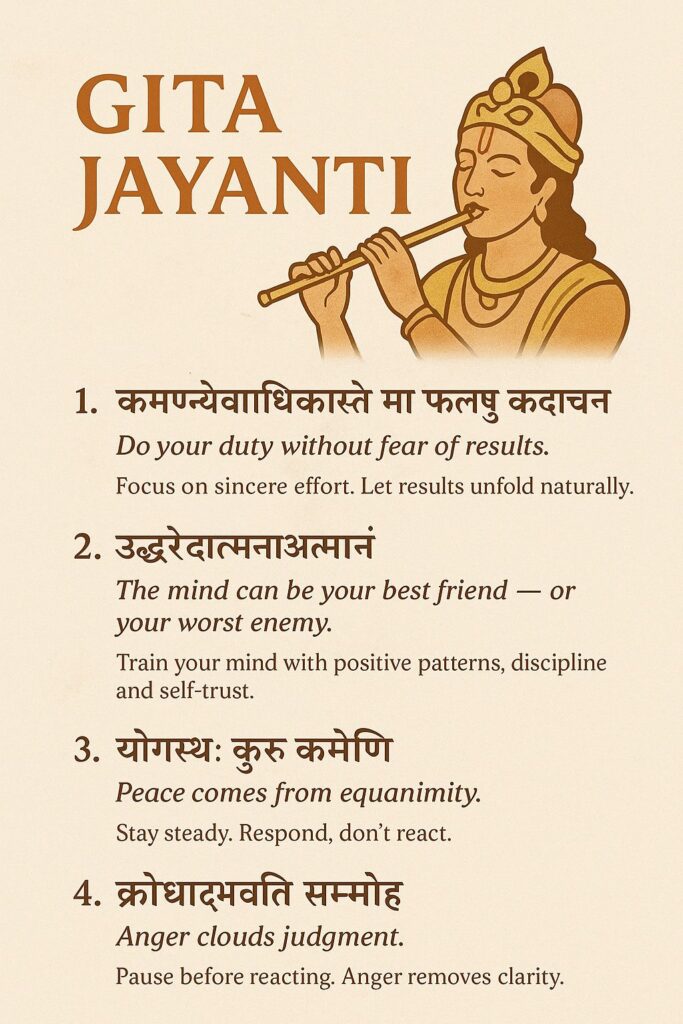
“Do your duty without fear of results.” श्लोक 2.47 – कर्मण्येवाधिकारस्ते मा फलेषु कदाचन
Meaning:
You have the right to perform your actions, but not to control the results.
Where it helps:
• Work pressure and performance anxiety
• Fear of what others will think
• Parenting stress
• Exam or job-related stress
Takeaway:
Focus on sincere effort. Let results unfold naturally.
- “The mind can be your best friend — or your worst enemy.” श्लोक 6.5 – उद्धरेदात्मनाऽऽत्मानं
Meaning:
You must elevate yourself by your own mind; do not let your mind pull you down.
Where it helps:
• Self-doubt
• Negative thinking
• Overthinking before important decisions
Takeaway:
Train your mind with positive patterns, discipline, and self-trust.
- “Peace comes from equanimity.” श्लोक 2.48 – योगस्थः कुरु कर्माणि
Meaning:
Perform your duties with evenness of mind, unaffected by success or failure.
Where it helps:
• Emotional ups and downs
• Handling criticism
• When plans don’t go as expected
Takeaway:
Stay steady. Respond, don’t react.
- “Anger clouds judgment.” श्लोक 2.63 – क्रोधाद्भवति सम्मोहः
Meaning:
From anger comes confusion; from confusion, loss of memory; and from loss of memory, destruction of wisdom.
Where it helps:
• Family arguments
• Workplace conflicts
• Parenting challenges
Takeaway:
Pause before reacting. Anger removes clarity.
- “Your inner strength is greater than your fear.” श्लोक 4.7–8 – परित्राणाय साधूनाम्
These verses remind us that whenever unrighteousness rises, divine strength intervenes — externally and within us.
Where it helps:
• Facing unexpected problems
• Feeling helpless or overwhelmed
• Health scares or personal setbacks
Takeaway:
There is always support — inside and around you.
- “Change is the law of life.” श्लोक 2.14 – मात्रास्पर्शास्तु कौन्तेय
Meaning:
Pleasure and pain, heat and cold come and go. They are temporary.
Where it helps:
• Tough phases in life
• Emotional pain
• Health issues
• Financial struggles
Takeaway:
This moment too shall pass.
- “You become what you think.” श्लोक 17.3 – सत्त्वानुरूपा सर्वस्य श्रद्धा
Meaning:
A person’s life becomes aligned with their inner belief and mindset.
Where it helps:
• Building self-confidence
• Setting life goals
• Overcoming limiting beliefs
Takeaway:
Strengthen your mindset, and your life will follow.
How to Observe Gita Jayanti Meaningfully
You can celebrate today by:
• Reading even one chapter of the Gita
• Chanting a few shlokas mindfully
• Practicing silent reflection for 10 minutes
• Teaching children the value of dharma (right action)
• Offering gratitude for guidance in your life
• Applying one teaching consciously today
Small steps create powerful inner shifts.
Conclusion: The Gita Is a Companion, Not a Scripture Alone
Gita Jayanti is not just about remembering an ancient dialogue — it is about living the wisdom every day. Whether you are dealing with work stress, parenting challenges, personal loss, or inner confusion, the Gita offers a lamp that never dims.
As Krishna tells Arjuna: “Whenever you feel lost — look within. I am there.”


Dear Kaushik, beautifully written blog. Your Gita Jayanti post carries such profound wisdom — reading it felt like a breath of clarity. Shlokas, you selected are very relevant in our daily life. Thank you for sharing.
Thank you for sharing the immense potential of the knowledge and wisdom of Gita.