
Last year, as we reflected on Teachers’ Day, we explored why societies across the world pause to honour teachers and the profound role they play in shaping knowledge, character and values.
A year later, perhaps a different question is worth asking:
Who are the teachers in our lives?
The obvious answer is the person standing in front of a classroom. But education begins much earlier than school and continues long after we leave it. A parent teaches a child their first words. A grandparent passes on stories and traditions. A mentor opens a new way of thinking. A friend teaches us through experience. A spiritual guide helps us look inward. And sometimes, surprisingly, our own children become our teachers.
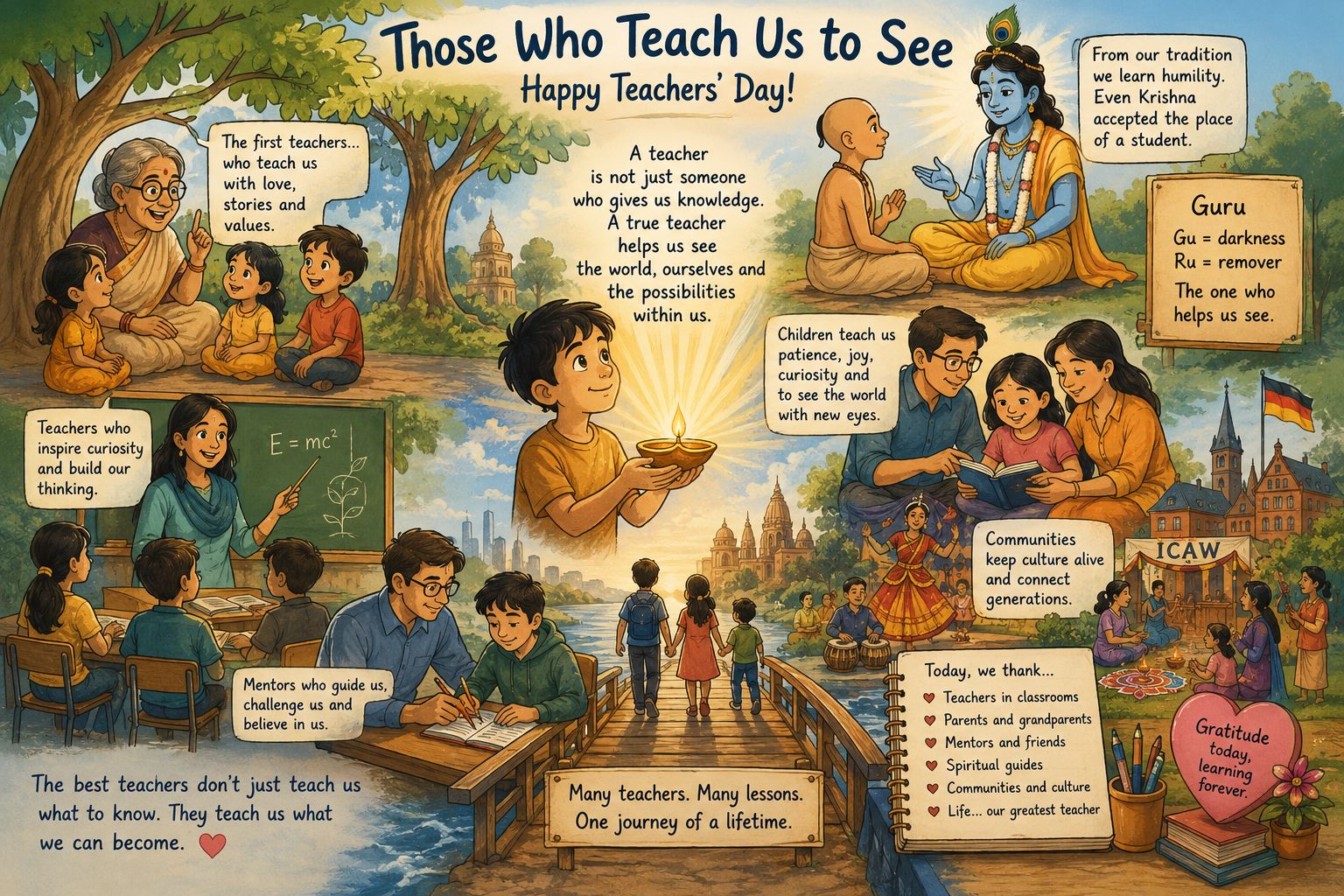
The more we reflect on it, the more we realise that a teacher is not simply someone who gives us knowledge. A true teacher helps us see—the world, ourselves, our responsibilities and the possibilities that lie ahead.
From Teacher to Guru
The Indian tradition has long understood teaching in a deeper sense through the concept of the Guru.
The word Guru is traditionally understood through gu, representing darkness or ignorance, and ru, the remover of that darkness. The Guru, therefore, is not merely a person who possesses knowledge. The Guru helps the seeker move from not knowing to knowing, from confusion to clarity, and ultimately from limitation towards understanding.
This idea is beautifully reflected in the familiar verse:
Guru Brahma, Guru Vishnu, Guru Devo Maheshwara.
The Guru is compared with Brahma, Vishnu and Maheshwara—not simply because a teacher creates knowledge, preserves wisdom or brings about transformation, but because genuine teaching can involve all three.
A teacher helps something new emerge within us. A teacher nurtures what has been learned. And a teacher sometimes challenges us to let go of what we thought we knew so that something deeper can take its place.
This is why the traditional Guru–shishya relationship is not merely about transferring information. It is a relationship built on learning, humility, trust and transformation.
Even Krishna Became a Student
Indian tradition offers a particularly profound reflection on this relationship through Shri Krishna.
Krishna, revered as the Supreme Lord, nevertheless participates in the Guru–shishya tradition and accepts the discipline of learning from His Guru. The symbolism is powerful.
If even Krishna accepts the position of a disciple, what does that tell us about the importance of humility in learning?
Knowledge begins with the recognition that we do not know everything.
The true student is therefore not simply the one who listens, but the one who remains open—to questioning, to correction, to new perspectives and sometimes even to being uncomfortable.
Perhaps this is one of the greatest lessons the Guru–shishya tradition offers the modern world: learning requires humility, and teaching requires responsibility.
Our First Teachers
Long before a child enters a classroom, education has already begun.
Parents and grandparents are often our first teachers. They teach us how to speak, how to listen, how to behave, how to distinguish right from wrong, how to deal with failure and how to treat other people.
Much of what shapes us is never written in a textbook.
Children learn by watching how adults speak to one another. They learn kindness by experiencing it. They learn responsibility by seeing it practiced. They learn resilience by watching how their parents respond when life does not go according to plan.
For families living away from their ancestral homeland, this role can become even more meaningful.
Indian parents raising children in Germany, or elsewhere outside India, often find themselves teaching two things at once: how to belong to the world in which their children are growing up, and how to remain connected to the culture from which their family comes.
Language, stories, festivals, music, food, traditions and values become part of that education.
It is not about preserving the past unchanged.
It is about giving the next generation a bridge between where they come from and where they are going.
When the Student Becomes the Teacher
There is another beautiful dimension to teaching: it does not always move in one direction.
Adults often believe they are teaching children, but children teach us too.
They teach us patience. They teach us curiosity. They remind us to ask questions. They challenge assumptions that we have carried for years. They introduce us to new ways of thinking and, sometimes, simply remind us to look at familiar things with fresh eyes.
The relationship between teacher and student is therefore not always fixed.
Sometimes the student grows up to become the teacher. Sometimes the teacher becomes the student.
This is particularly relevant in a world that changes faster than any previous generation has experienced. Technology, science, society and culture are constantly evolving. The ability to learn—and to remain willing to learn—has become as important as the knowledge we already possess.
Perhaps the best teachers are therefore also lifelong students.
Communities Are Teachers Too
Education does not belong only to schools and families. Communities teach us as well.
A culture is passed from one generation to another through stories, celebrations, music, dance, language, food, rituals and shared experiences.
When a community celebrates Diwali, Navratri, Holi or Independence Day, it is doing more than organising an event. It is creating opportunities for one generation to introduce another to its heritage.
This is especially important for children growing up in multicultural societies.
They can learn to appreciate their Indian heritage while simultaneously becoming active participants in German society. They can learn that cultural identity does not have to be a choice between this or that.
In fact, it can be an opportunity to learn from both.
The German educational tradition encourages questioning, independence and critical thinking. The Indian tradition has historically placed a deep emphasis on reverence for knowledge, gratitude towards the teacher and continuity of wisdom.
Our children do not have to choose between these values.
The future belongs to those who can learn from both.
And communities such as ICAW have a small but meaningful role to play in creating spaces where such learning can happen naturally.
What Makes a Great Teacher?
So what makes someone a great teacher?
Knowledge is certainly important. A teacher must have something meaningful to share.
But knowledge alone is not enough.
A great teacher also needs compassion—to understand that every learner is different.
A great teacher needs patience—because understanding does not always arrive at the same pace for everyone.
And perhaps most importantly, a great teacher needs character.
We often remember teachers not simply because of the lessons they taught us, but because of how they made us feel about ourselves.
A teacher may be the person who noticed a student’s potential before the student could see it themselves.
The person who encouraged a child who was struggling.
The person who asked a difficult question that stayed with us for years.
The person who showed, through their own conduct, what integrity, kindness or courage looks like.
In that sense, the greatest teachers do more than teach us what to know.
They teach us what we can become.
The Teacher Must Remain a Student
There is a final lesson hidden within all of this.
To teach others, we must continue to learn ourselves.
A teacher who stops learning eventually becomes limited by yesterday’s knowledge. A teacher who remains curious can continue to grow alongside every new generation of students.
This applies not only to professional educators, but to parents, mentors, community leaders and all of us.
The world our children will inherit will be different from the world we grew up in. Preparing them for that world cannot simply mean giving them answers.
We must also teach them how to ask better questions.
How to think critically.
How to listen.
How to adapt.
How to distinguish knowledge from wisdom.
And perhaps most importantly, how to remain humble enough to say:
“I don’t know. Let us learn together.”
A Day of Gratitude
Teachers’ Day, therefore, can be much more than a celebration of a profession.
It can be a moment of gratitude for everyone who has helped shape who we are.
For the teacher who taught us our first letters.
For the professor who challenged our thinking.
For the parent who taught us our first values.
For the grandparent who kept a tradition alive.
For the mentor who believed in us when we doubted ourselves.
For the Guru who helped us look beyond ourselves.
For the community that continues to connect one generation with another.
And perhaps even for those who taught us through difficult experiences, reminding us that some of life’s most important lessons do not come from classrooms at all.
On Teachers’ Day, ICAW joins in expressing gratitude to all those who teach, guide, inspire and nurture.
May we remember that teaching is not merely the transfer of knowledge.
It is the lighting of a lamp.
And sometimes, the greatest gift a teacher can give us is not an answer—but the ability to see more clearly for ourselves.
Happy Teachers’ Day.